Your strategy on one page
Seven boxes to decide where you compete, how you win and what you leave out. To print, hang on the wall and bring out when it's time to say no.
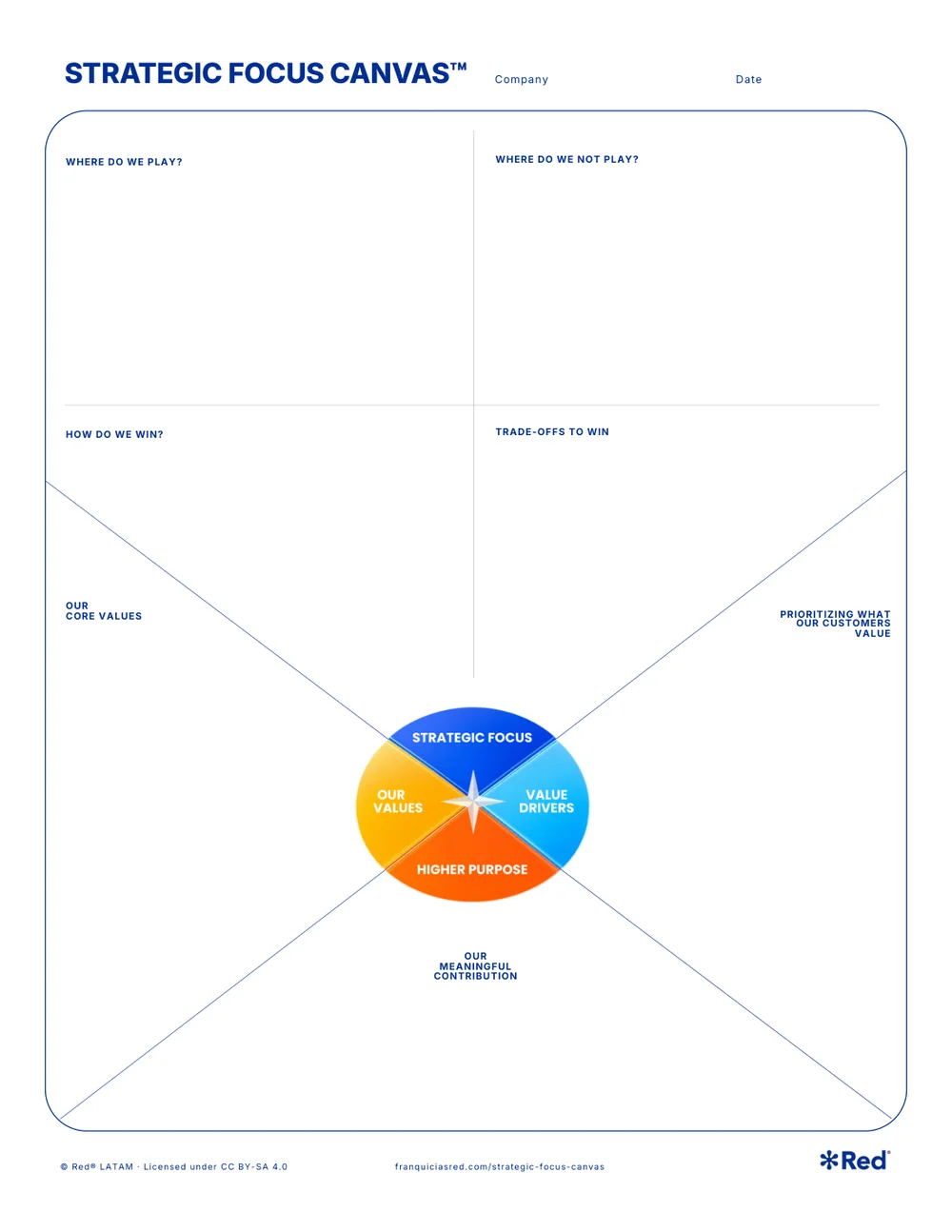
Three axes describe, one decides
First you write down who you are and for whom. Then you make the four decisions that put everything else in order.
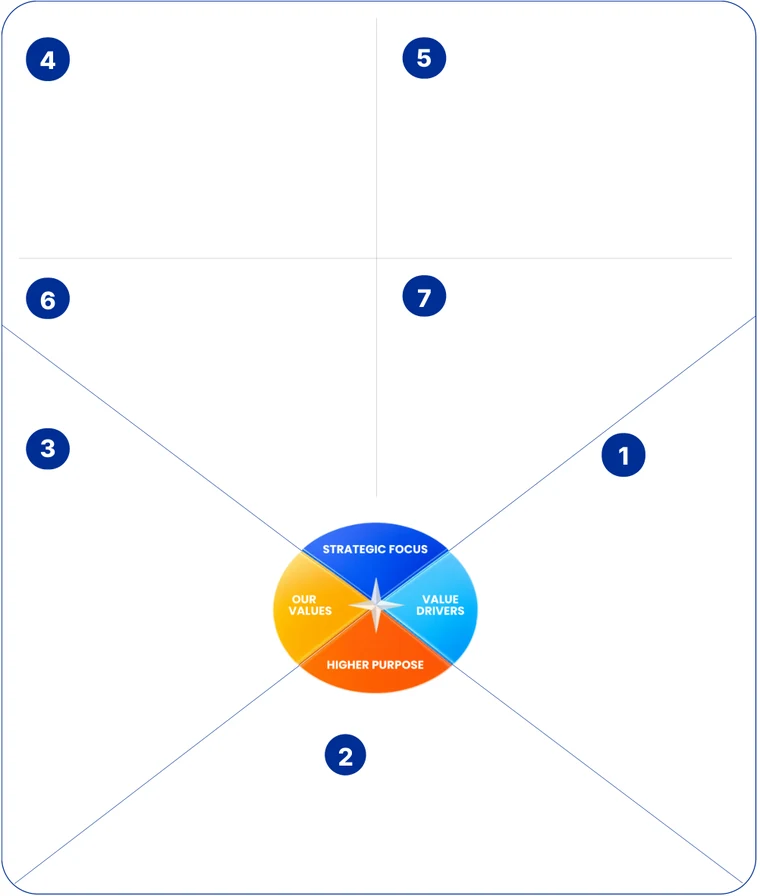
Describe
The few reasons they choose you when they have alternatives, in their own words.
One sentence with what you contribute and the impact it has, on the customer's ground.
Three to five, each with a line that says what it means for you.
Decide · Strategic Focus
Which customers, geography, categories and channels you choose.
What you decide not to serve, even when you're asked to.
A single path: differentiation or cost.
The things you give up to protect the way you win.
The order matters. If you start with the decisions, you'll write choices that sound good and don't survive the first quarter. The guide that comes with the download explains what goes in each box and what to avoid.
What a finished Canvas looks like
The case from Chapter 20 of the book: a regional industrial equipment distributor, with around 90 employees, two decades in operation and three generations of the same family in management.
- Plants with continuous production where an hour of downtime costs more than the service
- Food, plastics and packaging industries
- A four-hour driving radius from their two warehouses
- Workshops and intermittent production
- Public works and price-based tenders
- Equipment sales without a service contract
- Customers outside the radius, even if they pay the freight
- Through differentiation: guaranteeing response time by contract, with a penalty if we miss it
- Don't sell equipment without a service contract
- Don't compete on catalog breadth, list price or payment-term financing
- Response first: we answer before we know the solution
- Proven competence: we don't weigh in on equipment we haven't mastered
- Time to get back into production
- Being able to commit to a date with third parties
- Demonstrable technical competence
- The problem not coming back
- That no customer's production line ever stops because of something we could have solved
1 · What their customers value
- Time to get back into production
- Being able to commit to a date with third parties
- Demonstrable technical competence
- The problem not coming back
2 · Their meaningful contribution
- That no customer's production line ever stops because of something we could have solved
3 · Their core values
- Response first: we answer before we know the solution
- Proven competence: we don't weigh in on equipment we haven't mastered
4 · Where do we play?
- Plants with continuous production where an hour of downtime costs more than the service
- Food, plastics and packaging industries
- A four-hour driving radius from their two warehouses
5 · Where do we not play?
- Workshops and intermittent production
- Public works and price-based tenders
- Equipment sales without a service contract
- Customers outside the radius, even if they pay the freight
6 · How do we win?
- Through differentiation: guaranteeing response time by contract, with a penalty if we miss it
7 · Trade-offs to win
- Don't sell equipment without a service contract
- Don't compete on catalog breadth, list price or payment-term financing
The hard part was a single line
Don't sell equipment without a service contract
eliminated about a third of the previous year's deals. They decided it because every standalone sale consumed hours from their four certified technicians, the scarce resource the entire strategy rested on.
Your Canvas, ready to print
- The quick guide: in what order to fill it in, what goes in each box and what to avoid
- The Canvas in three sizes: Letter for each leader, Tabloid for the wall and a 24 × 36 in poster for the workshop
- The downloads appear right here, and we also email them to you
Need it in Spanish? Versión en español
Get the Canvas
Free. We just need your name and email.
Your Canvas is ready
Start with the guide: it tells you what to do with the rest. We've also emailed you these links.
Start here
The quick guide
How to fill it in, in what order and what to avoid.
Download PDF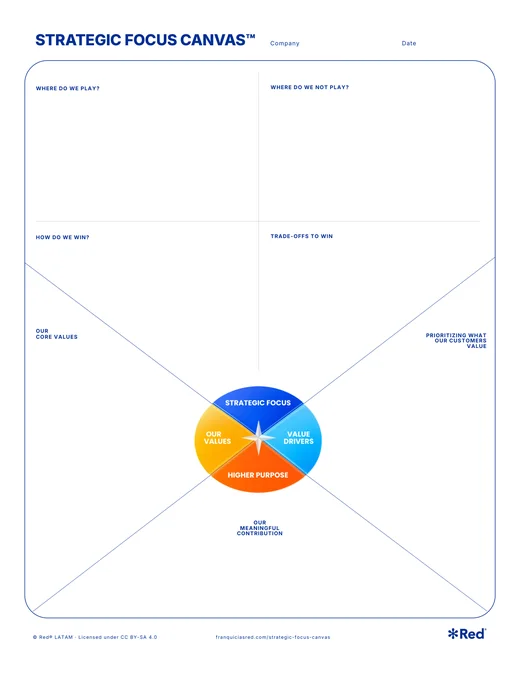
Worksheet
Each leader fills it in alone, by hand, before the meeting.
Download PDF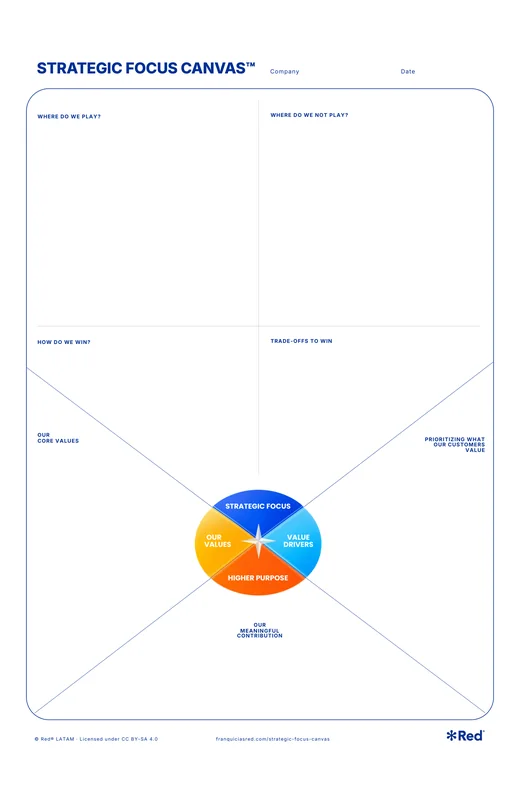
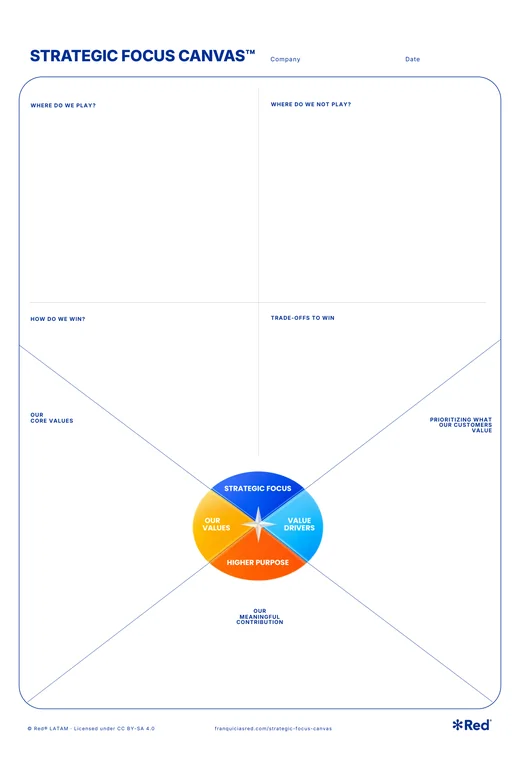
Workshop poster
To work on as a team with sticky notes. Have it printed on matte paper at a print shop.
Download PDFUse it, share it, adapt it
The Strategic Focus Canvas™ is licensed under Creative Commons Attribution-ShareAlike 4.0. You can copy, adapt and share it, including in your client work, as long as you credit Red® LATAM and share your adaptations under the same license.
How to credit it
A chapter for every box, in two editions
The book works through each box with exercises and closes with the distributor's complete case. The same work, in English and in Spanish.
Before you download it
How is it different from the Business Model Canvas?
The Business Model Canvas describes how a business model works: customers, channels, resources and costs. The Strategic Focus Canvas™ records the decisions that focus it: where you play, where you don't, how you win and what you give up to win. They complement each other.
Can I use it with my team or my clients?
Yes. It is licensed under CC BY-SA 4.0: you can copy, adapt and share it, including in client work, as long as you credit Red® LATAM and share your adaptations under the same license.
Do I need the book to fill it in?
Not to get started: the quick guide explains what goes in each box and in what order. The book The Irreplaceable Company devotes a chapter to each box, with exercises and a complete case.
Boxes still empty? Bring your Canvas
Information is rarely what's missing. What's missing is leading the conversation where two partners read the same business differently. Half an hour, free of charge and with no sales pitch.
Book a conversation